Inside Ibrahim Al Midfa's House: The Elephant Door & Our Family Story

My sister knows my soft spot for history and culture so her discovery sent me straight to The Chedi Al Bait, Sharjah. There was a wall I needed to see at their Library.
The Library was booked. Then booked again. I did a few polite laps of the corridor, listening to conference noise slide under the door. When I finally slipped in during a meal break, I gave the shortest pitch possible: my sister, a rumor, a wall. The crowd turned out to be museum curators (my people) and they even offered to take a picture if I found what I was looking for.
I did. On that wall: my beloved late grandfather, Abdul Razzaq Badran, beside Ibrahim Al Midfa and a third figure, a young house hand who ran errands back then. Tears happened. Proof in hand, I needed the rest of the story.

I sent the photograph to my friend Alexander McNabb, brilliant, relentlessly curious, and the author behind Children of the Seven Sands. He knew the name, of course, and he knew the granddaughter: Noura Al Noman, acclaimed Emirati science-fiction writer. He introduced us.
The Reveal
We arranged to meet and I knew who else needed to be there because the moment belonged to him too: my father, Prof. Badran Badran.
Sunday morning, my parents drove up from Abu Dhabi; my sisters and I came in from Dubai. I sold my father a thin cover "Sharjah breakfast" which he believed for about 3 intersections. We walked into The Chedi Al Bait; he'd never been inside. In the corridor he spotted Al Midfa's name and tried to stop to deliver context (family reflex). I steered him onward. There was a reveal to keep.
At the threshold I greeted Noura, just a hello and she stood with us, no context. We stepped into the room. He clocked the first portrait and murmured, "A very important journalist." Then we said, "Look to your right."
Jaw. Drop. On the wall: his father, our dearly missed grandfather, standing beside Ibrahim Al Midfa in a photograph that must have been captured in the late 1940s. Time sat down with us and refused to move.
Only then did I turn to him and say, "Baba, this is Noura. She's Ibrahim Al Midfa's granddaughter." The room tightened, then opened. That was the moment everything aligned.

The Stories
Noura anchored the day with details only a family carries. This was her birthplace, this very wing. It was morning; there wasn't time to reach the hospital; her father was away; her mother delivered her in a room here. Ibrahim Al Midfa was her maternal grandfather. She fell in love with reading in his library; the house made a reader before it made a writer.
Then the ledger of a life: Ibrahim Al Midfa, Sharjah's first journalist and man behind Oman, the first newspaper in the history of the UAE (1927); hand-written and passed from reader to reader (one issue posted in Souq Al-Arsa). In all, he produced 5 hand-written newspaper manuscripts, plus a more underground title, "Sawt Al Asafeer" (The Birds' Voice) often described as Twitter before Twitter. His papers argued for pan-Arabism. He also advised 4 sheikhs in his public role.
He hosted a Majlis Thaqafi, regular gatherings much like the great Paris salons where arts, philosophy, literature, and politics were put on the table among distinguished attendees and discussed. To make those conversations possible through the heat, he designed a circular barjeel (wind tower) by hand. Her aunt Muneera recalls him drawing the round barjeel, unique in the Emirates as almost all are square; it still stands behind his majlis, slim as a minaret, and the talk it sheltered helped shape a city's mind.
About Ibrahim Al Midfa
Ibrahim Al Midfa passed away in 1982, in his eighties. On the scale of everyday life, Noura painted him clearly: 'dammo khafeef' meaning easy company, a natural humorist. After 9 pm, he was not to be disturbed. The news took the room; mornings found him with a newspaper in hand.
Why My Grandfather Was There
Abdul Razzaq Badran was among the first Arab pioneers to introduce modern photography and early applied arts to Palestine, Kuwait, and Jordan, leaving a rare archive of Mandate-era Palestine and pre-independence Kuwait. In the late 1940s, his assignments brought him to what was then the Trucial Coast to document key events and figures; that work led him to Ibrahim Al Midfa, and the encounter became the portrait we found.
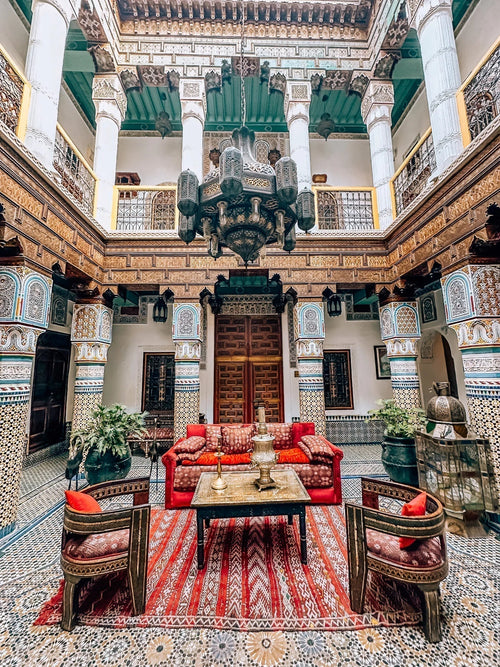
We took our own picture beside The Elephant Door, original to Al Midfa's home, dated 1944. Same spot, new generation.

Noura Al Noman
A champion of Arabic YA sci-fi, she wrote the award-winning Ajwan (Etisalat Best YA Novel, 2013), followed by Mandaan (2014) and Saydounia (2016). She'll also tell you, with a smile, that one of her failed passions is raising bonsai trees.
The line runs forward, too. Noura told us her cousin, another grandson, spent 3 years in South Korea working on the Emirates Mars Mission Hope Probe. From a great-great-grandfather hand-publishing Oman to a grandson helping launch a spacecraft, ink to orbit in 1 incredible family.
A Father's Words
"My feelings are of pride and appreciation for recognizing my father's visit to Sharjah and his meeting with Ibrahim Al Midfa, whom he recognized as an Arab intellectual and statesman." — Prof. Badran Badran
The room did exactly what it was built to do: hold people and stories in the same light. We walked out with the feeling you get after a great chapter, complete, and ready to be reread.