If I had a dirham for every time someone asked me what to wear in the UAE, I could probably retire from tour guiding and spend the rest of my life in a caftan somewhere on the coast.
So let me save us both some time and put it all in one place.
I have lived in the UAE for over 30 years. I run cultural tours across Dubai, Abu Dhabi, and Sharjah. My inbox is essentially a rolling referendum on hemlines, shoulder coverage, and whether ankles count. This guide is the answer to every one of those emails.
The short version: the UAE is far more relaxed than most people expect, but it is not a free-for-all. Context matters. Where you are going determines what you should be wearing. Think of it as dressing for the occasion, not dressing for the country.
The General Rule
You do not need to cover your hair to walk around Dubai. You do not need to wear an abaya to enter a mall. You will not be arrested for wearing shorts at the beach.
However, you should be thoughtful. The UAE is a country with deep cultural traditions and a population that includes people from over 200 nationalities. Respectful dressing is not about restriction. It is about reading the room, and the room changes depending on where you are.
Fabrics and the Heat
Before we get into where to wear what, a quick word on what to wear full stop. The UAE is hot. Not "warm afternoon in the south of France" hot. Properly, why-is-the-steering-wheel-burning-my-hands hot, especially between May and October.
Stick to natural fabrics: cotton, linen, and lightweight blends. They breathe, they dry fast, and they will not turn you into a walking greenhouse. Avoid synthetic fabrics and anything too tight or layered. Loose-fitting clothes are your friend here. They keep air circulating and keep you comfortable even when the temperature has no interest in your comfort.
The good news is that if you packed wrong or packed light, the UAE is one of the easiest places in the world to buy clothes. Malls are everywhere, markets are everywhere, and you can find everything from budget basics to designer pieces without having to look very hard.
Mosques
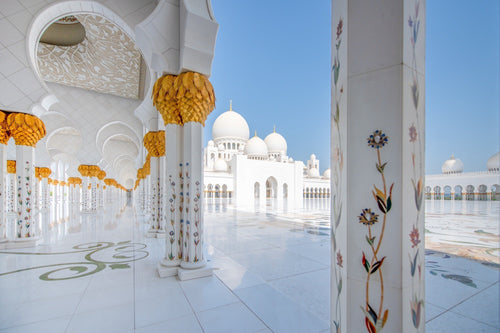
This is where the dress code is non-negotiable. Both men and women need to cover up. Women need long sleeves, full-length trousers or skirts, and a head covering. Men need to cover their shoulders and wear full-length trousers or at least below-the-knee shorts.
A quick note on head coverings: those cute little neck-tie scarves that look great with a summer outfit will not do the job here. They are too short to properly wrap and cover your hair. What you want is a proper shawl, something long enough to drape over your head and wrap comfortably. It does not need to be fancy, it just needs to do the job.
Coverage needs to be complete: ankles covered, no slits, no gaps, no "just a little bit showing." If it is a little bit showing, it is too much.
Young girls are usually exempt, but once they reach a certain age, the same dress code applies.
Sheikh Zayed Grand Mosque, Abu Dhabi
The mosque no longer provides complimentary coverups for visitors. You will need to bring your own or purchase one nearby. There are shops near the entrance selling abayas, shawls, and even full one-piece outfits starting from AED 45. There is also Souq Al Jami', a mall right underneath the mosque, where you will find everything from simple coverups to beautifully crafted abayas and shawls that you might actually want to keep wearing long after the mosque visit. Your call. If you know you are only ever going to wear it once though, save your money and just bring something from your suitcase that does the job.
Gates, timings and the visitor pass you now book ahead are all in my Sheikh Zayed Grand Mosque visitor guide.
A note on white linen
Avoid it. It can turn transparent, and even if you think it is "only slightly see-through," it will not pass.
If you are joining my Sheikh Zayed Grand Mosque tour or the Abu Dhabi Cultural Tour, ladies do not need to worry about any of this. I supply curated pieces that look good and photograph even better, so no one has to scramble or show up wrapped in a hotel towel.
Jumeirah Mosque, Dubai
They still provide complimentary coverups for visitors on their guided tours, so you are covered. Literally. Note: shoes come off before you enter the prayer hall.
Qasr Al Watan (Presidential Palace), Abu Dhabi
This one catches people off guard. Qasr Al Watan enforces a dress code at entry: no shorts, no sleeveless tops, no exposed shoulders or knees. This applies to both men and women. It is a working government building and a cultural landmark, and they take it seriously. If you turn up in a vest and shorts, you will be turned away. Plan accordingly. See-through fabrics and flip-flops are out too.
Zayed National Museum, Abu Dhabi
The museum asks for "modest attire that is not likely to cause offence, and is not otherwise inappropriate to the culture of the UAE." That is the whole rule. No list, no diagram.
In practice: shoulders and knees covered, nothing you can see through. Shorts are a gamble. Do not take it.
Malls
Yes, malls in the UAE have a dress code. It is usually posted near the entrances. You do not need to dress conservatively, but do not show up in something you would wear to a pool party.
If you push it too far, security may approach you and ask you to cover up. It is not a dramatic scene, but it is not a conversation most people want to have while holding a shopping bag. Just keep it reasonable and you will be fine.
Souks, Old Dubai, and the Creek
You will not be stopped at a souk entrance for what you are wearing, and most of it is outdoors. Shorts and dresses are fine. The main thing to think about is your feet. These are walking neighbourhoods with uneven ground, narrow lanes, and zero escalators. Skip the heels. Comfortable shoes are not optional here, they are the whole strategy.
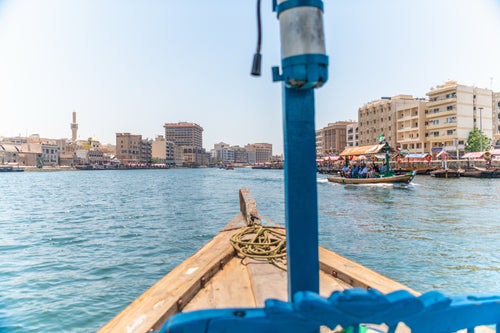
One more thing: if you are taking an abra across the Creek or wandering through the textile souk, wear something colourful. Vivid colours look incredible against the backdrop of the old buildings, the water, and the wooden boats. You will thank yourself when you look at the photos later.
That colourful outfit gets its full workout on my Old Dubai walking tour: Al Shindagha, the abra across the Creek, the Spice and Gold Souks, about 4 hours on foot. Wear the good shoes.
Restaurants and Bars
This is where the UAE is most relaxed. Dubai especially. Dress however you like. Some high-end restaurants have their own dress codes (no sportswear, smart casual minimum), but that has nothing to do with cultural norms and everything to do with the restaurant being particular.
Beach clubs, rooftop bars, casual dining: wear what you want. Nobody is policing your neckline at brunch.
The Beach
Swimwear at the beach is completely fine. Bikinis, one-pieces, whatever you are comfortable in. Public beach, hotel beach, beach club, no difference.
What is not fine: swimming in your underwear. It happens. Please do not be that person.
Water Parks
Standard swimwear is all you need. The water parks here are world-class and fully set up for tourists. No dress code beyond what you would expect at any water park anywhere in the world. Just wear what is comfortable and what will survive a waterslide at speed.
Desert Safaris
Light, breathable clothing. Sandals actually work better than closed shoes here. The sand is going to find its way into whatever you are wearing on your feet regardless, so you might as well make it easy to shake out.
And bring a scarf or shawl for your head. The wind on the dunes will rearrange your hair in ways you did not agree to, and you will step out of that Land Cruiser looking like Einstein after a motorcycle ride. A headscarf keeps everything in place, protects you from the sun, and honestly, it fits the whole desert look. You will thank yourself when the photos come out.
Abu Dhabi
The question I get most often, so here is the direct answer: yes, you can wear shorts in Abu Dhabi. Walking around, at the beach, on the Corniche, in a mall, nobody is going to stop you. Abu Dhabi is a capital city with a large international population and it is not the place people imagine before they arrive.
What women actually wear in Abu Dhabi is the same range you see in Dubai: dresses, jeans, shorts, skirts, abayas, all of it, often on the same street. There is no requirement to cover your hair, and no requirement to wear an abaya unless you are entering a mosque.
Where it does tighten up:
- Sheikh Zayed Grand Mosque. Full coverage, headscarf for women, and the mosque no longer lends garments. Details in the mosque section above.
- Qasr Al Watan. Enforced at entry: no shorts, no sleeveless tops.
- Zayed National Museum. Modest attire, in their words. Shoulders and knees, nothing sheer.
- Government buildings. Shoulders and knees covered. This one is a rule, not a courtesy.
Beaches are straightforward. Swimwear is fine at Corniche Beach, the hotel beaches and the beach clubs, same as Dubai.
The short version: dress for Abu Dhabi exactly as you would for Dubai, and carry something to cover up with if a mosque or the palace is on your list that day.
Sharjah
Sharjah is more conservative than Dubai. This is not a suggestion, it is the vibe of the entire emirate. Shoulders and knees covered is genuinely expected, not just recommended. If you are visiting the Sharjah Art Foundation, the Heritage Area, or the souks, dress accordingly. It is a beautiful emirate with serious cultural depth, and dressing respectfully is part of experiencing it properly.
During Ramadan
During the holy month, it is respectful to dress a bit more conservatively across the board, even in places that are normally relaxed. This does not mean you need to change your entire wardrobe. Just be a little more mindful. Cover your shoulders and knees in public spaces, and save the more revealing outfits for evenings out or hotel settings. Hotels are hotels. They cater to tourists and the usual rules apply there regardless of the season.
Public Transport
The Dubai Metro, buses, and trams do not have an official dress code, but they are shared public spaces and you will be around families, workers, and commuters. Use common sense. Beachwear on the metro is not a good look for anyone. If you are heading to or from the beach, throw something over your swimsuit before you tap your NOL card.
Women-only cabin on the Dubai Metro
It exists for a reason and it is clearly marked. If you are male and accidentally walk in, you will know very quickly.
The Secret Weapon: A Light Shawl
Here is my number one packing tip for women visiting the UAE, and it has nothing to do with cultural dress codes.
Carry a light shawl. Always.
The UAE runs its air conditioning the way other countries run their central heating: at full blast, year-round, with zero mercy. You will walk in from 42 degrees outside and immediately enter what feels like a walk-in freezer. Malls, restaurants, museum galleries, taxis, hotel lobbies. My guests regularly start a museum tour reaching for their shawls, then warm right back up once we step outside.
A shawl solves everything. It covers your shoulders if you are entering a mosque or a palace. It keeps you warm in an overly air-conditioned restaurant. It works as a headscarf when needed. It folds into nothing in your bag. It is the single most versatile item you can bring on a UAE trip, and I will stand by that until the air conditioning situation changes. Which is to say, forever.
What About Men?
Men are a different case, but a few things still apply. Mosques require trousers or at least below-the-knee length. Short sleeves are fine. Capris are fine, shorts above the knee are not. Qasr Al Watan has the same no-shorts, no-sleeveless rules. Malls ask that you do not walk around shirtless, which should not need saying, but apparently does.
At beaches and pools, standard swimwear is fine. Old Dubai, souks, heritage areas: shorts are completely fine. Restaurants and bars: just match whatever dress code the venue sets, same as anywhere else.
Frequently Asked Questions
Can you wear shorts in Abu Dhabi?
Yes, nearly everywhere. City, Corniche, beach, malls, all fine. Three places to leave them at the hotel: Sheikh Zayed Grand Mosque, Qasr Al Watan and Zayed National Museum. Shoulders and knees covered clears all three.
Can you wear shorts to Zayed National Museum?
No. The museum asks for modest attire and leaves the specifics to you, which is exactly how people get it wrong. Shoulders and knees covered, nothing sheer.
What do women wear in Abu Dhabi?
The same range you see anywhere in the UAE: dresses, jeans, shorts, skirts and abayas, often on the same street. There is no requirement to cover your hair or to wear an abaya unless you are entering a mosque. Dress as you would in Dubai and carry a light cover-up if a mosque is on your plan for the day.
Do you have to cover your hair in Dubai?
No. Nowhere in Dubai requires you to cover your hair except inside a mosque, where women need a headscarf. There is no requirement on the street, in malls, in restaurants or at the beach.
Do women have to cover up in the UAE?
No, not in the sense people usually mean. Sleeveless tops and shorts are normal in Dubai and Abu Dhabi, malls and souks included, as long as they are within reason. Beaches, hotels, restaurants and bars are relaxed. Sharjah is the exception, where shoulders and knees covered is genuinely expected, and mosques are the one place with a firm rule.
What is the UAE dress code for men?
Shirts with sleeves and full-length trousers for mosques and Qasr Al Watan. Everywhere else, shorts and t-shirts are fine. Going shirtless is only acceptable at the beach or a pool.
What is the dress code in Sharjah?
Shoulders and knees covered across the emirate, and this one is genuinely expected rather than merely suggested. Sharjah is more conservative than Dubai and Abu Dhabi, so dress accordingly for the Heritage Area, the souks and the Art Foundation.
Can you wear a bikini on the beach in the UAE?
Yes, at beaches, hotel beaches and beach clubs across Dubai and Abu Dhabi. Swimwear is not appropriate on public transport or in malls.
What should I wear in Dubai as a woman?
Less than you are packing for. Sleeveless tops and shorts are normal here, malls and souks included, and the only real line is crop tops and very short shorts. Carry a light shawl: it gets you into a mosque and survives restaurant air conditioning, which is what you will actually use it for.
The Nutshell
Mosque: Long sleeves, full-length bottoms, hair covered (women). Ankles covered, no slits. Bring your own coverup for Sheikh Zayed Grand Mosque. Avoid white linen.
Qasr Al Watan: No shorts, no sleeveless tops. Shoulders and knees covered. Enforced at entry.
Zayed National Museum: Modest attire, their words. Shoulders and knees covered. Leave the shorts.
Malls: Keep it reasonable. Nothing you would wear to a pool party.
Abu Dhabi: Same as Dubai. Shorts are fine. Cover up for the mosque, Qasr Al Watan and Zayed National Museum.
Sharjah: Shoulders and knees covered across the emirate. Expected, not just recommended.
Souks and Old Dubai: Wear what you like. Comfortable shoes essential. Bright colours photograph beautifully.
Restaurants and Bars: Dress as you please. Some venues have smart casual codes.
Beach: Swimwear fine at the beach, public or hotel. Not on public transport or in the malls.
Water Parks: Standard swimwear. No special dress code.
Desert Safari: Light clothing, sandals, headscarf for the dunes.
Public Transport: No beachwear. Throw something on over your swimsuit.
Ramadan: A bit more conservative in public spaces. Hotels remain as usual.
General: When in doubt, cover your shoulders and knees. A light shawl fixes almost everything.
Still with me?
The rest of this guide is one email away.